Cow 804 is a moderately sized kiwi cross in your herd that milks around 500 solids. She calved two weeks ago, and although she had milk fever, she’s already on track for exceeding her production history this season.
Cow 804 is a moderately sized kiwi cross in your herd that milks around 500 solids. She calved two weeks ago, and although she had milk fever, she’s already on track for exceeding her production history this season. You noticed that she had less milk yesterday afternoon, and this morning her production is still down. Your phone alerts you that her ruminations are low and by afternoon, you get your vet out and she’s standing next to 804 with her stethoscope on listening for a ‘ping.’ What’s gone wrong?
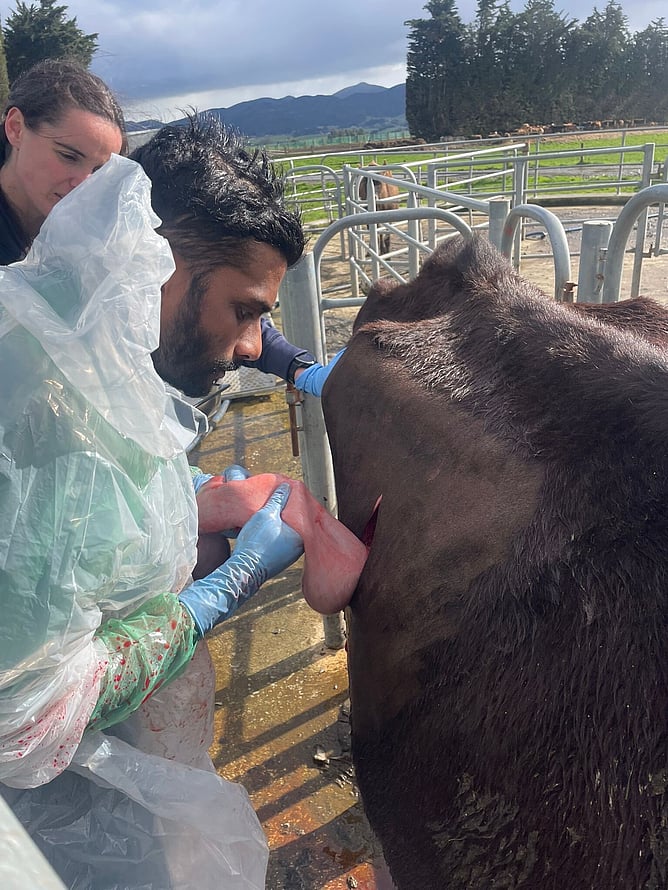
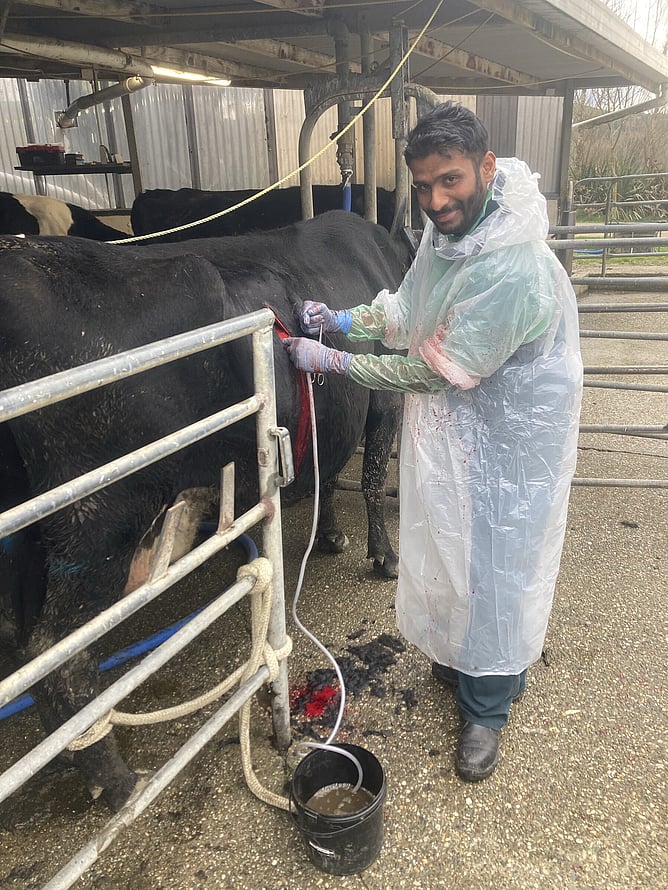
Please note, this article contains graphic images of a cow undergoing surgery by Vet Shan Kaluthunga.
Let’s start with some background:
Cows have a complex digestive tract designed for processing high fiber diets. There are four distinct compartments in the tract, three of which make up the ‘forestomach’ of the cow: the rumen, the reticulum, and the omasum. The fourth compartment - the abomasum - is what we consider the ‘true’ stomach.
Most of us are familiar with the rumen – the large fermentation vat filled with micro-organisms located on the left side of the cow. We may not have heard as much about the abomasum or “true” stomach. This compartment lives on the right side of the animal suspended from the body wall on a loose attachment. The loose suspension can allow the abomasum to move out of its normal position, fill with gas, and prevent normal flow of feed through the digestive tract. In veterinary terminology, we call this condition “Displaced Abomasum.”
The abomasum can displace either to the left side of the cow (Left Displaced Abomasum/LDA) or further to the right side of the cow (Right Displaced Abomasum/RDA).
Left displaced abomasum is less of an emergency. Although it is uncomfortable for the animal and she feels sick, she can live with this in the short term.
Right displaced abomasum is an emergency because the stomach is at risk for torsion. If the stomach twists, the blood supply is cut off, and the abomasum can die leading to circulatory collapse in the cow.
Displaced abomasum is common in high-producing systems around the world. Most LDAs occur during the early lactation (first 4-6 weeks), while RDAs can occur at any time and are dangerous due to the torsion potential. Displacements of the abomasum are predisposed by low rumen fill, reduced forage to concentrate ratio, and reduced muscle contractions/tone in the abomasum.
Decreased muscle contraction/tone in the abomasum can be due to increased volatile fatty acids (lower fiber/higher carbohydrates); low calcium (milk fever, or subclinical hypocalcaemia); or accumulation of sand in the abomasum.
Cows are at higher risk for a displacement if they have:
· Milk fever
· Ketosis
· Retained fetal membranes
· Metritis
· BCS higher than 5
Abomasal displacements often start during late pregnancy. The growing calf pushes the rumen forward, allowing more space for the abomasum to slide away from where it normally lives on the bottom right side of the cow. It can move under the rumen towards the left side of the cow. When the rumen is pushed forward, its volume is reduced by up to one third of its normal capacity - allowing for further movement of the abomasum underneath. Add to this the decrease in feed intake close to giving birth and the volume of the rumen is reduced even further. This creates an opportunity for the abomasum.
Next, comes the gas.
Normally gas produced in the abomasum goes back into the rumen as the muscles in the wall of the abomasum contract. If muscle tone in the abomasum is decreased, the trapped gas can cause the abomasum to the drift upwards either on the left or right sides of the cow. As you can see, there are many possible contributing factors to decreased muscle contractions in the abomasum.
So....
How do you know if your cow has an LDA in early lactation?
If you have collar technology, you might be alerted that this animal has:
· Reduced rumination (<350)
· Decreased eating time
· Lower general activity
Perhaps you text your favourite veterinarian and the message reads: “804 a bit off. Calved two weeks ago, treated for milk fever. Production dropped yesterday, not eating. Watery shit.”
You might get a text back saying “Let’s have a look, I’ll come ‘ping’ her this afternoon.”
We detect displaced abomasum by listening with flicking and a stethoscope for a fluid/gas interface where it shouldn’t be. The ‘ping’ that we listen for is the sound you might hear if you flicked a basketball. If we confirm that there is a pinging sound on the left side of 804, she probably has an LDA.
After diagnosis, we’ll need you to help us determine our treatment plan. We have options, but our aim is to keep in mind the outcome and economics as well as what’s best for both you and the cow.
To get the abomasum back to its correct location, our options include
· Surgical intervention
· Roll & Toggle
· Medical or Conservative Management
Surgery is done with the cow standing in the head bale. Most vets like to use the right side of the cow, so having a gate that opens here is useful. An advantage of surgery is that it allows the veterinarian to visualise the condition of the organs and perhaps “explore” the abdomen of the cow if the LDA is complicated or there are other things going on in there. The gas is drained off the abomasum using sterile tubing, and then the surgeon manually pulls the abomasum back to where it belongs and sutures it into place.
A roll and toggle procedure involves casting the cow with ropes and rolling her onto her back. We listen for the change in position of the gas and then punch a trocar through the belly of the cow into the abomasum (much as if you were stabbing a cow for bloat). We allow the gas to come through the trocar before passing two special toggles down the trocar to hold the abomasum in position. There is no surgery required for this procedure; however, the LDA needs to be large and uncomplicated for us to choose this method as it is what we call a “blind” procedure: we want to be very sure of what we are doing!
If a displaced abomasum is caught early enough, or is one that seems to come and go, we may be able to conservatively manage this condition. What we mean by “conservative management” is a focus on reversing the factors that may have caused the displacement in the first place. This is achieved by reversing ketosis, milk fever, and supporting the cow to meet her energy and metabolic requirements to regain contractility in the abomasum. We do this with fluid pumping, calcium supplementation, ketol, and energy in the form of dextrose. It is not always successful, but in some cases if we can get things moving in the tract, the displaced abomasum may correct itself.
A word about outcomes:
From an economic standpoint, early diagnosis of displaced abomasum is key. For a simple LDA caught early, we expect to regain milk production within 24 hours. The longer 804 lives with a displaced abomasum, the harder it is to get milk production back because blood supply to the udder is reduced. A general rule of thumb is that if diagnosed and corrected within 3 days, we should be able to regain the productivity of this animal.
So. 804 calved two weeks ago, you’ve treated her for milk fever; she’s dropped in production, and you’ve been alerted that she has reduced rumination and isn’t eating. You’ve called your favorite veterinarian (who was very excited to help) and 804 was diagnosed with an LDA. You went for a surgical correction and because all of this happened early, tonight 804 is back in the paddock eating, and is likely to return to her expected production. When it comes to displaced abomasum, time is milk.