With lambing sneaking up on us, now is the time to put things in motion to make it as successful as possible.
Lots of you will be scanning soon, which is an ideal time to check on your ewes’ condition and trace element status, and make a plan for spreading them out later in the season. Some of the main opportunities at this time include:
Scanning and nutrition
The last six weeks of gestation is the most crucial time of the year to get the feeding of ewes right. Once you have scanning information, you can start calculating what is required during this time. Planning early will give you more options if you identify a deficiency, e.g. ordering grain/nuts, finding grazing for hoggets, or sourcing more good quality baleage.
Maintenance feeding for a ewe is shown in the table below (assuming mixed-length leafy grass at ME concentration of 10.8MJME/kgDM):

Once you get to six weeks out from lambing, the requirements increase based on pregnancy status (single, twin, triplet). The below table shows how much extra MJME each ewe needs per day, above maintenance levels, based on her pregnancy status and stage:
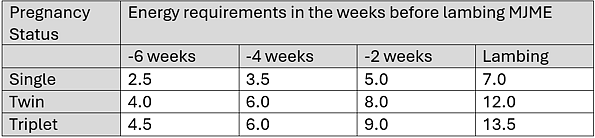
For example:
A 70kg ewe carrying twins, six weeks out from lambing, will require 11MJME maintenance + 4MJME extra = 15MJME/ewe/day.
With grass at 10.8MJME/kgDM, this equates to 1.4kgDM/head/day.
As the pregnancy advances and she reaches lambing date, her requirement will lift to 2.1kgDM/day, which will become increasingly difficult for her to harvest (she simply won't be able to eat enough in 24 hours)! Your best chance of coming close to achieving this is to provide LOTS of really good quality feed, i.e. offering grain or nuts, or sourcing great quality baleage.
Paddock selection
Thinking ahead about where you want to put each mob at lambing time is key.
High stocking density in small paddocks increases social stress, and therefore, mismothering of lambs. On the other hand, paddocks that are too large will result in the separation of lambs and ewes due to animals having to walk long distances to graze and get to water sources.
Ewes should be moved into their lambing paddocks 2-3 days before they are due to lamb and then not moved. The stress of movement can affect their behaviour and ability to settle into the paddock. They will also spend a number of hours at their chosen birth site before lambing, especially the two-tooths.
Body condition scoring
Body condition scoring (BCS) is a simple, quick, and low-cost tool that can be used for the management of ewes during gestation. Achieving BCS 3-3.5 at the end of gestation has a significant impact on lamb survival, birth weights, colostrum production, and ewe energy levels.
Body condition scoring can be performed by your vet, or they can train you to do your own. BCS is measured on a scale of 1-5, with scores of 3-3.5 indicating good feeding and high production. BCS and live weight are related; typically, an increase in one condition score equates to a weight gain of 7-9kg. Using BCS instead of weight is important, as heavier ewes can be in poor condition if they have a large frame size.
Identifying ewes with a lower BCS at the time of scanning allows for quick intervention. You only have 2-3 weeks after scanning to improve condition of ewes with a BCS of less than 3. These ewes need to be drafted off and preferentially fed. Talk to your vet about doing a faecal egg count (FEC) and whether using a drench on these animals is necessary.
Selenium testing
Low selenium levels in stock can be detrimental, particularly pre-lambing as it can be a cause of lamb losses.
Selenium is also important for the immune system, so a deficiency can make the flock more susceptible to infections, such as salmonella, campylobacter, toxoplasmosis, listeria, and pinkeye; even when they are fully vaccinated.
Your vet can test for selenium; it requires a blood sample to be taken from five ewes from the flock. Usually testing one flock is sufficient if they have all been on the same pastures. However, if flocks are on different blocks with varying selenium prill history, it would be worth testing another group.
Scanning time is a good opportunity to supplement animals with selenium, if needed, as they are already in the yards. As these samples only take 4-5 days to get back from the lab, your vet can take these samples a week before scanning time.
Iodine supplementation
Lambs are susceptible to a condition called goitre, an enlargement of the thyroid gland caused by iodine deficiency in pregnant ewes.
Affected lambs are often born weak or stillborn and struggle to survive cold exposure. It is most common in newborn lambs whose ewes graze iodine-deficient soils or goitrogenic crops (like brassicas) in late pregnancy.
Supplementing ewes with long-acting iodine at scanning time can reduce the risk of goitre in lambs. It needs to be administered at least 8 weeks before lambing to have an effect. Iodine comes in an oral drench or an injectable (Flexidine).
Give your KeyVet, or the Farm Services team in-clinic, a call if you need a hand with BCS, are keen to get some samples taken from your ewes, or need to order some pre-lamb supplies.