We strongly recommend dairy farms in Southland and South Otago should consider preventatively vaccinating their stock against Salmonella this autumn.
There are around 2600 strains of Salmonella identified worldwide. The most common strains seen in cattle in New Zealand are S. Typhimurium, S. Give, S. Bovismorbificans (primarily affects the gut) and S. Brandenburg (primarily causes abortions).
In spring 2025, numerous outbreaks due to these serotypes were seen on both the South Island and the North Island. Last year, MPI reported the most cases of Salmonella in cattle ever recorded in New Zealand (see Figure 1 below).
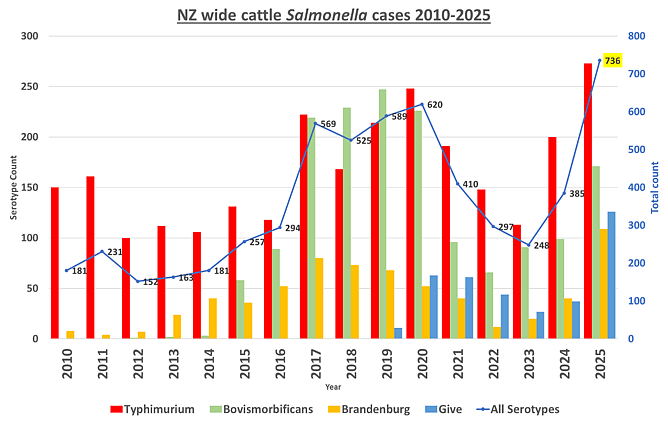
Figure 1. New Zealand bovine Salmonella case numbers between 2010-2025.
Source: MPI Animal Health Surveillance Team.
S. Bovismorbificans tends to cause higher death rates during outbreaks than S. Typhimurium: illness and death rates are reportedly up to 46% and 8% respectively, in adult cattle, and up to 75% and 50% respectively, in calves (Hulme-Moir, 2020).
There is also an emerging strain, S. Give, only identified in New Zealand since 2019. This serotype was confined to the North Island until 2024 when during an unseasonally wet spring, it emerged in Southland and since then, has been found in most regions of the South Island.
All Salmonella strains can cause severe illness and death, and they can infect people and make them sick too.
For the past two years in the southern region we have seen around 100 instances of Salmonella in cattle (see Figure 2 below). Based on the number of dairy herds across the region, that is roughly 1 in every 10 farms having an outbreak.
With the increase in the number of local cases, it's highly likely there will an increased number of carrier animals around, and therefore an increased risk of outbreaks in the South in 2026.
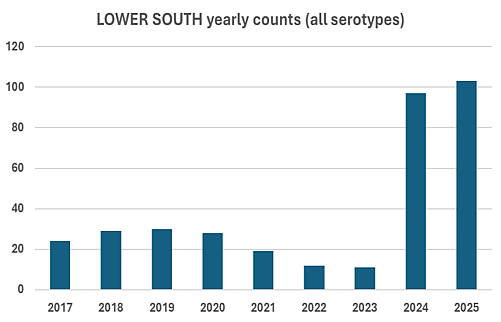
Figure 1. Southern bovine Salmonella instances between 2017-2025.
Source: MPI Animal Health Surveillance Team.
What do I see on my farm if my stock have Salmonella?
Generally, cows will be depressed, go off their milk and have poor appetites, and they often have foul-smelling, khaki-green diarrhoea. Unexplained deaths and high temperatures are also often seen. If affected with S. Brandenburg, cows often abort, have retained membranes, and become very sick.
If you see any of these signs, or suspect something is wrong, your vet should be contacted immediately. They will collect a faecal sample to be cultured, to confirm diagnosis and figure out which strain of Salmonella is present.
Remember, Salmonella is a zoonotic disease and can be spread to humans, so extra care should be taken with hygiene when handling sick animals.
What causes Salmonella outbreaks?
On average, it is estimated that 9% of a dairy herd in New Zealand are carrier animals for Salmonella at any time. Carrier cows are not sick and often won’t become sick until they come under a lot of stress, such as during calving or at dry-off time. Carriers can shed Salmonella bacteria for months or even years.
As well as direct animal-to-animal contact, Salmonella is also spread by infected body fluids (e.g. faeces) or aborted material, which can be further spread by scavenging animals such as seagulls or hawks. While commonly implicated, ducks are not the main source of disease, or feed per-se.
Salmonella bacteria can survive in the environment for a long period of time – even years in ideal conditions, like wet paddocks, effluent ponds, or dry, shady areas such as cattle yards. Conversely, it can be killed on hard surfaces within days if conditions are freezing or very hot.
Once animals become clinically sick from Salmonella, they shed very high numbers of Salmonella bacteria into the environment, furthering the rapid spread the disease during an outbreak.
What is the impact of a Salmonella outbreak?
In a 500-cow milking herd, a common Salmonella outbreak scenario of 10% becoming sick and 2% dying, the direct costs through dead cows and loss of their future milk would be over $30,000 (based on 2025 prices). This is not counting the milk reduced from the supply during the outbreak, or the impact on recovered cow's production and reproduction, nor the unmeasurable risk to humans. This far outweighs the cost of preventative vaccination for the herd.
What makes a farm high-risk?
Recent history of cases in the herd.
Recent outbreaks on neighbouring farms / geographic hotspot.
Common water source with other farms.
Very large herd sizes.
Mixing of cattle from different sources.
Sudden diet changes.
Intensive feeding (pelletised magnesium supplement, continuous troughs, PKE)
No or incomplete vaccination programme against Salmonella.
Most of all: stress, which could come from calving, dry-off, transport, yarding, other disease outbreaks (e.g. BVD), extreme weather events, etc.
What can I do to reduce the risk of an outbreak?
Mitigate the risk factors listed above, where possible.
Isolate sick animals.
Remove and bury any aborted material quickly.
Store and feed supplements appropriately to minimise faecal contamination.
Collect and store colostrum and calf milk with high hygiene standards. Never use milk from scouring cows for calves.
Avoid grazing at-risk groups of animals on effluent paddocks (e.g. young calves).
Vaccinate cattle with Salvexin+B (preventatively or in an outbreak). This has been proven to reduce bacteria shedding, reduce incidence of clinical cases, and reduce stock losses during outbreaks.
What is Salvexin+B and how is it used?
Salvexin+B is New Zealand’s only Salmonella vaccine for cattle and sheep. Made in New Zealand, it protects the common strains of Salmonella we see here.
It is encouraged as a preventative vaccination rather than a cure in the face of an outbreak. For the initial course, two doses are required 4-8 weeks apart. It's recommended the second is given at least 2-3 weeks before a risk period for an outbreak (such as calving time and spring weather). If used in the face of an outbreak, new cases usually stop 10-14 days after the first vaccination, however, a second vaccination is still recommended. In subsequent years, animals require an annual booster.
Late April-May is an ideal time to vaccinate. Given the heightened risk of Salmonella outbreaks in the South this year, the very high value of dairy animals, and the comparatively low cost of the vaccine, we encourage you to talk to your vet about a vaccination programme for your herd now.
Salvexin+B is registered pursuant to the ACVM Act 1997, No. A007886.