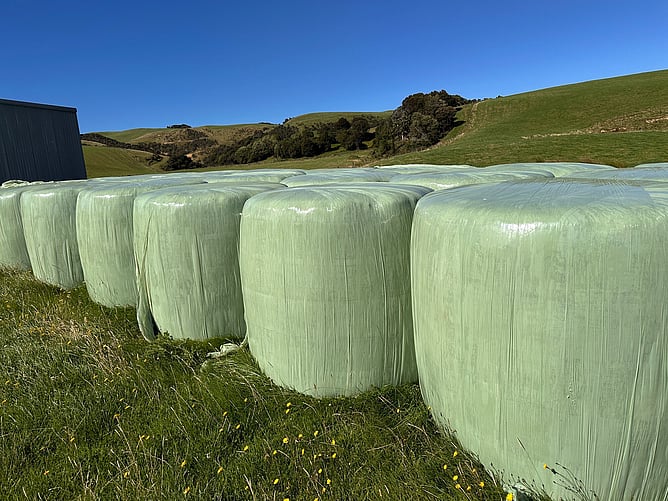
The following tales of two cows who ingested baleage wrap are an important reminder to all farmers to be careful what you do with the plastic when opening bales, particularly as we head into winter. Cattle, sheep and deer are all at risk of mistaking any scrap pieces left in the paddock for something edible and this can cause big problems.
Please note, this article contains medical photographs taken during post-mortem examination.
A short while ago, I was asked to carry out a post-mortem exam on a cow that had bloated and died earlier in the day.
This was a cow that I had seen before for a severe pinkeye infection, and she was quite blind in both eyes. However, she was not expected to die from that! She had been pregnancy scanned the day before, so I also had to consider the possibility of a perforated rectum.
When I opened the abdomen, there was no sign of a perforation or peritonitis, but the intestines were very empty and gassy, and the stomach contents were unusually watery.
In the chest, the oesophagus (which takes food from the mouth to the rumen) was four or five times the normal size. The top section of it was full of chewed up grass, but lower down, I found the end of a bit of baleage wrap…
A tangle of baleage wrap was thoroughly wedged at the point where the oesophagus passes through the diaphragm and into the rumen. When something like this happens, the cow can’t burp out gas, which causes pressure on the heart, lungs and large blood vessels in the chest.
Death then occurs due to asphyxiation and/or circulatory failure, which was what had happened to this poor cow.
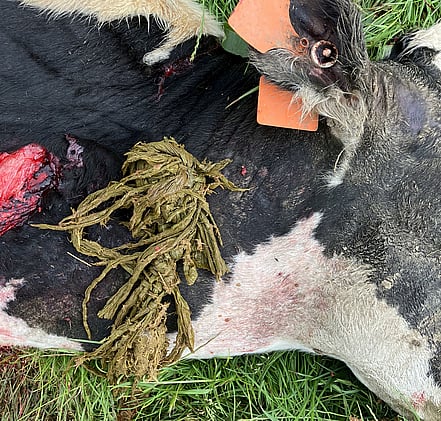
Case 1: The knot of baleage wrap that had been wedged in the cow’s oesophagus.
A couple of weeks later, on a different farm, I went with Emma (one of our new graduate vets) to see a heifer that had suddenly gone off her milk and looked tucked up in the guts.
She was quite agitated and kept going down in the crush. There were no faeces present in the rectum when I put my arm in, but she passed a small amount of very watery diarrhoea later. Otherwise, we couldn’t find much on examination (there were no “pings” to indicate a twisted stomach, for example). We discussed the possibility of exploratory surgery to check for an obstruction, but decided to try medical treatment first.
Two days later, there was no improvement, and the farmer asked us to come out and look at her again. The heifer was dehydrated, so we decided to drench her with fluids via a stomach pump. However, the rumen was so impacted that the liquid came straight back out again around the tube!
At this point we decided to risk opening the rumen surgically and searching for a blockage. Opening the rumen isn’t something to undertake lightly, due to the potential for contents to leak out and cause peritonitis.
When we got in there, I immediately found the end of a large piece of baleage wrap. In this case, it was blocking the exit from the rumen, so only liquid could pass through.
We removed all of the baleage wrap and, at the time of writing this, the heifer is still alive and doing well.
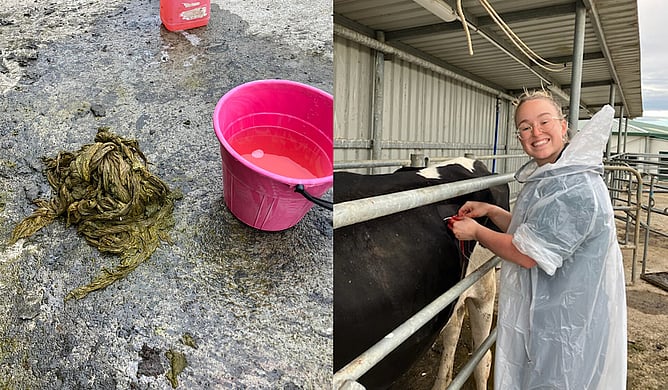
Case 2: The baleage wrap ball we removed from the heifer’s rumen and Emma stitching up the incision.
These two cows aren’t unique. Once a grazing animal gets something in their mouth, they find it difficult to spit it out.
We often find baleage wrap inside stock during post-mortems. While small bits don’t always cause problems, if it bunches up or lodges in narrow parts of the gut it can be lethal.