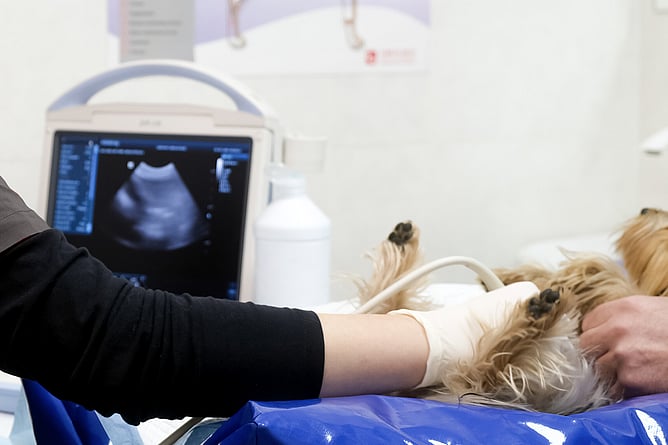
Sometimes, X-rays don’t give us the full picture — especially when we need to look closely at your pet’s internal organs and how they’re functioning in real time. That’s where ultrasound comes in.
Ultrasound is a safe, radiation-free imaging tool that uses sound waves to create live images of your pet’s soft tissues and organs. It’s commonly used to investigate concerns such as vomiting or diarrhoea, loss of appetite, weight loss, difficulty urinating, to assess organ health, or to check trauma-related issues like internal bleeding or fluid build up in the chest or abdomen.
Because ultrasound shows movement as it happens, it helps our vets understand not just what your pet’s organs look like, but how they’re working.
Why your vet may recommend an ultrasound
Safe and non-invasive: Ultrasound uses sound waves – not radiation – making it safe for repeated use and suitable for pets of all ages, including pregnant animals.
Real-time insight: Unlike X-rays, ultrasound allows us to watch things as they move. This is especially helpful for assessing heart function, intestinal movement, blood flow, and fluid build-up.
Clearer views of soft tissues: Ultrasound provides excellent detail of organs such as the liver, kidneys, spleen, pancreas, bladder, and uterus – areas that can be difficult to fully assess with X-rays alone.
Earlier, more accurate diagnosis: By detecting changes sooner, ultrasound can help identify conditions at a more treatable stage, leading to faster and more targeted care for your pet.
Guiding procedures with precision: Ultrasound can be used to guide fine-needle samples or biopsies, reducing the need for more invasive exploratory surgery.
Comfortable for your pet: Most ultrasound procedures are quick and relatively stress-free. In many cases, they can be performed without sedation, or with only mild sedation to help your pet relax.
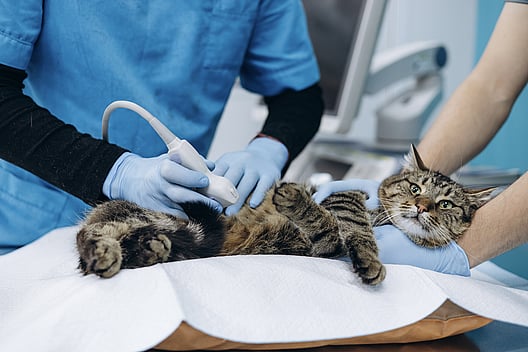
What happens during an ultrasound
During the scan, a small probe is gently placed against your pet’s skin. This sends sound waves into the body, which bounce back from different tissues and are converted into images on a screen for the vet to interpret.
To get clear images, we usually need to shave a small area of fur. This allows the probe to sit directly on the skin and avoids air pockets that interfere with image quality. While the shaved area may look a bit odd at first, the coat typically grows back within a few weeks.
Your pet may also receive light sedation to help them stay calm and comfortable, which improves image quality and reduces stress.
Are there any limitations?
Ultrasound is extremely useful, but it isn’t suitable for everything.
Sound waves can’t pass through air or bone, so lungs and bones can’t be assessed with ultrasound. However, these areas can still be examined using other imaging tools such as X-rays.
Gas in the stomach or intestines can sometimes obscure underlying organs.
In larger or overweight pets, image detail can be reduced at greater depths.
In some cases, your vet may recommend additional imaging such as X-rays, endoscopy, CT, or MRI to get the clearest possible diagnosis.
Clear answers, better care
Ultrasound is a valuable tool in veterinary care, helping us diagnose problems accurately while keeping your pet as comfortable as possible. It allows us to make informed decisions, avoid unnecessary procedures, and tailor treatment to what your furry friend truly needs.
If you have any questions or concerns about needing an ultrasound or other imaging for your pet, please talk to us. We’re always happy to explain how it helps and what to expect.